
The Difference Between Linear Way Covers and Way Covers
Machine tools used in CNC production, automation lines, and precision engineering operate under constant exposure to chips, coolant, dust, and heat. Without proper protection, critical motion components wear faster, accuracy drops, and downtime increases. This is where protective systems like way covers become part of the machine setup.
Let’s break down the difference between standard way covers, linear way covers, and linear rail covers, with a focus on how each type supports different motion systems and machine requirements.
What Are Way Covers?
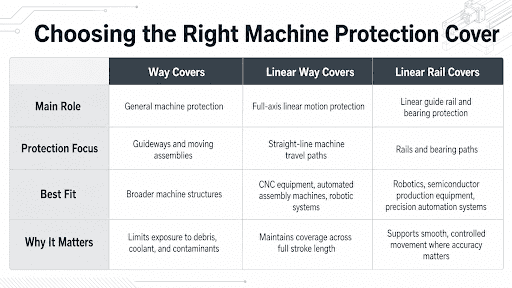
Way covers are protective components installed on machine tools to shield guideways and moving assemblies. Their main function is to block debris, coolant, and other contaminants from reaching sensitive mechanical parts.
These covers come in different constructions depending on machine use, including fabric-reinforced types, metal telescopic systems, and hybrid builds. In production environments, they support consistent machine operation by limiting exposure to damaging particles.
Centryco produces custom way cover systems that match machine size, travel range, and operating conditions across multiple industries.
Understanding Linear Way Covers
Linear way covers are a specific category of way covers designed to protect machines that operate on straight-line motion systems. These covers are commonly found in CNC equipment, automated assembly machines, and robotic systems.
The covers move along the axis of machine travel, expanding and compressing as the machine operates. This movement helps keep guideways protected through the full stroke length.
Linear way covers are often selected when machines require continuous motion protection across long travel distances. Their structure is built to handle repeated cycling while maintaining consistent coverage across linear paths.
What Are Linear Rail Covers?
Linear rail covers protect linear guide rails and bearing systems used in high-precision motion setups. Profile linear rail covers are a type of linear rail cover designed to closely match the profile of the guide rail, providing targeted protection while maintaining smooth, precise movement. Linear guide rails and bearing systems play a direct role in movement accuracy, so exposure to contaminants can quickly affect performance.
Profile linear rail covers are commonly used in robotics, semiconductor production equipment, and precision automation systems. Their close-fitting design helps shield rails from debris and coolant while minimizing interference with machine movement.
Compared to standard way covers, linear rail covers provide more targeted protection for linear guide rails and bearing systems used in precision motion applications.
Key Differences Between Cover Types
Way covers act as the general category covering multiple machine protection designs.
Linear way covers focus on full-axis movement protection in linear motion machines.
Linear rail covers concentrate on shielding guide rails and bearing paths where accuracy matters most.
Each type differs in coverage area, motion handling, and application focus. Way covers serve broader machine structures, while linear versions narrow protection down to specific motion systems and precision components.
Why Selection Matters
Choosing the correct cover type affects machine uptime, maintenance cycles, and part longevity. Contamination on guideways or rails leads to wear that reduces accuracy and increases service needs.
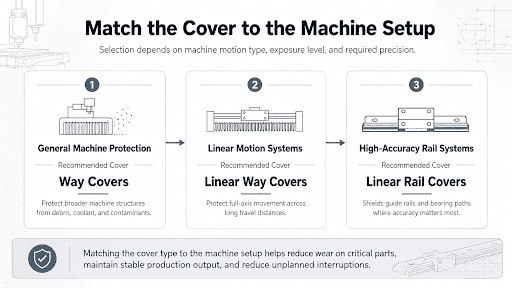
Matching the cover type to the machine’s motion system helps maintain stable production output and reduces unplanned interruptions.
Selection also depends on machine motion type, exposure level, and required precision.
General machine protection typically uses way covers. Linear motion systems are better suited for linear way covers. High-accuracy rail systems rely on linear rail covers to maintain stable movement performance.
Matching the cover type with the machine setup helps reduce wear on critical parts.
Get the Right Cover Before Your Machine Starts Complaining
If your machine could talk, it would probably ask for better protection. Don’t wait for wear, downtime, or accuracy issues to make the decision for you.
Get in touch with Centryco to find the right way covers, linear way covers, or linear rail covers for your setup. The right fit today can save a lot of trouble tomorrow.
FAQ: Way Covers, Linear Way Covers, and Linear Rail Covers
How do I know if my machine needs way covers or linear rail covers?
It comes down to the motion system. Machines with general sliding or guided movement typically use way covers, while systems relying on precision linear rails benefit more from linear rail covers designed specifically for that structure.
What happens if machine covers are not installed?
Without proper protection, chips, coolant, and dust can enter exposed components. This often leads to faster wear, reduced accuracy, and more frequent maintenance or part replacement.
Are linear way covers suitable for high-speed machines?
Yes, provided they are properly engineered for the machine’s stroke length, speed, and operating environment. In many cases, they are used in automated systems where repeated motion cycles are common.
Can existing machines be upgraded with different cover types?
In many setups, yes. Machines can often be retrofitted with updated way covers or switched to linear way covers or linear rail covers depending on the motion system and available mounting space.
What factors affect the lifespan of way covers?
Operating speed, exposure to abrasive materials, coolant type, and maintenance frequency all influence service life. Proper selection for the application plays a major role in durability.
Does Centryco work with custom machine layouts?
Centryco provides application-based configurations for way covers, linear way covers, and linear rail covers, depending on machine design and operating conditions.
